

How AI food estimates work
AI estimates give you a starting point. Review them against your meal.
From a photo to food candidates- Review estimates
Review the foods and estimated amounts found by AI. Information that still needs checking stays marked for review.
- Edit amounts
Change the amount to match what you ate, then save. You can edit the estimate instead of accepting it as it is.
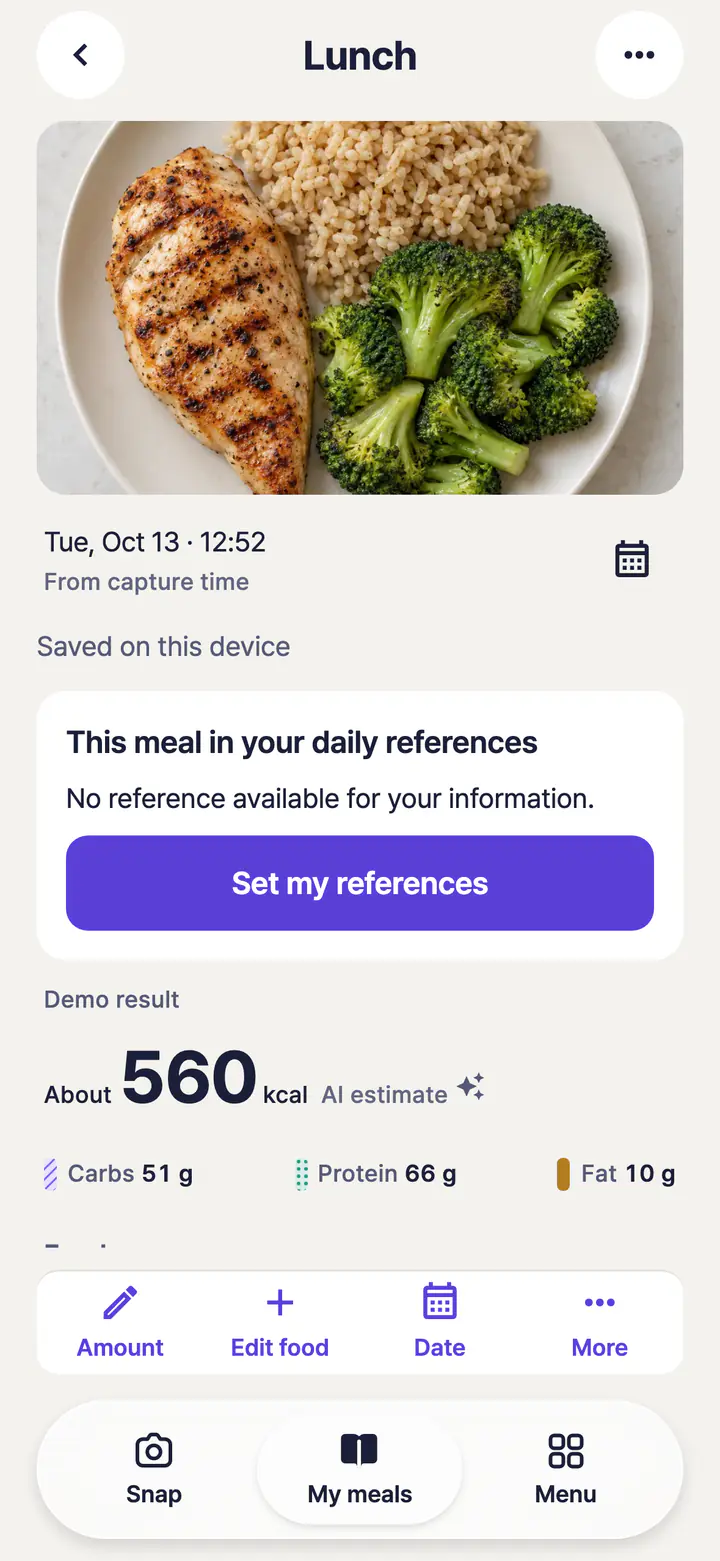
Example · Not a customer record
Review the foods and estimated amounts found by AI. Information that still needs checking stays marked for review.
Contents
From a photo to food candidates
Analysis looks for possible foods based on what is visible. Similar-looking foods and mixed dishes can be misidentified. Check items marked for review or matched to a similar food against what you actually ate.
A food name appearing on screen does not mean every ingredient has been identified. Use “Edit food” to replace an incorrect match or add a missing food.
How amounts affect nutrition values
The same food gives different nutrition totals at different amounts. Calories, like other nutrition values, are calculated from the matched food data and the amount recorded. Calculations use the estimated amount and the reference amount in the food data, so check both the food and its amount.
The matched nutrition data provides reference values for that food. Your product, recipe, or ingredient proportions may differ. Values you enter yourself and values calculated from recipes should be distinguished from measurements in the original data.
What a photo cannot tell us
A photo cannot reveal every hidden ingredient, component of a sauce, exact weight, amount of cooking oil, or uneaten portion. Foods that look alike can have different nutrition values because of their ingredients and preparation.
HelloMi does not guarantee a fixed accuracy rate or margin of error for photo analysis. Do not use an analysis result alone to decide whether a food contains an allergen or to make a medical decision.
HelloMi supports everyday eating habits. It is not a medical device and does not diagnose, treat or prevent disease. Talk to a professional before making medical decisions.
Missing information and your edits
For a food the food data does not have, AI estimates the nutrition values and labels them “AI estimate”; the same values are reused for foods of the same name. An entry may still have only a food name or be missing some nutrition values. Do not read an unknown value as zero. A total based on partial information may not cover the whole meal.
Foods shown early during analysis are a preview and are not included in meal totals. Once the results are ready, check the foods and amounts and edit them using what you know.
If your edits differ from a new AI result, open “Compare with the AI result” to choose. You can keep your edits without applying the AI result.
Nutrition data sources
HelloMi uses selected food data and recipes from the sources below. This does not mean every food from each source is available in the app, or that a source update immediately changes the app's data.
- USDA SR28 — US Department of Agriculture, Agricultural Research Service, Nutrient Data Laboratory. USDA National Nutrient Database for Standard Reference, Release 28. Version Current: September 2015. USDA FoodData Central
- USDA FNDDS 2021–2023 — U.S. Department of Agriculture, Agricultural Research Service, Beltsville Human Nutrition Research Center. FoodData Central. Download released 2024-10-31. USDA FoodData Central
- Australian Food Composition Database – Release 3 — Food Standards Australia New Zealand. AFCD data files
- Ciqual 2025 — Anses. 2025. Table de composition nutritionnelle des aliments Ciqual. doi:10.57745/RDMHWY, updated 2025-11-19. Ciqual data
- 日本食品標準成分表(八訂)増補2023年 — 日本食品標準成分表(八訂)増補2023年から引用(文部科学省). MEXT food composition tables
- Korean Food Composition Database 10.4 — Rural Development Administration, 2026. Korean Food Composition Database 10.4. RDA food composition data
- CoFID 2021 — Public Health England (2021). McCance and Widdowson's The Composition of Foods Integrated Dataset 2021. Contains public sector information licensed under the Open Government Licence v3.0. CoFID data
- Precise Hansik Recipes — rice dishes — Korean Food Promotion Institute, release dated 2025-03-20, KOGL Type 1. HelloMi calculated and adapted nutrient values from ingredient weights using the Korean Food Composition Database. Korean public data portal
Nutrition values calculated from these Korean recipes combine ingredient values through HelloMi's calculations. They are not official laboratory measurements of the finished dishes. Your own preparation and amount may differ from the reference recipe.
You can also find data credits and notices in “My profile > About & notices” in the app.
Your photos and data
Saving a photo on this device is separate from sending it for AI analysis. AI photo analysis requires the relevant consent. Open “My profile > AI & privacy” to review what you agreed to.
Deleting server analysis copies, deleting records on this device, and deleting an account are different requests. See Account and Data Deletion for their scope and process. The Privacy Policy explains what is sent, who processes it, and retention.